air compressor builds too much pressure
May 19, 2026
Air compressors are indispensable equipment in many businesses, workshops, and even residential garages. They power pneumatic tools, inflate tires, aid in painting, and perform many other tasks.
Is your air compressor over-pressurizing? When an air compressor generates excessive pressure, it can cause severe equipment damage, safety hazards, and reduced performance. Excessive tank pressure risks catastrophic failure and damage to downstream equipment, endangering operators and compromising the structural integrity of the compressed air system.
For distributors, OEM buyers, and fleet operators, a pressure regulation failure is rarely an isolated event — it points to a component-quality or maintenance-system gap that affects every unit in the field. Understanding why this happens, how to prevent it, and how to fix it is essential for anyone. If you are managing compressor components at scale, the final section covers sourcing options for replacement regulation assemblies.

Understanding why an air compressor builds too much pressure
Before tackling the problem of high pressure, it is essential to understand what air pressure is, how compressors work, and why pressure must be carefully controlled.
Air compressor pressure is the force exerted by compressed air inside a tank and its pipes, typically expressed in bars or PSI (pounds per square inch). This pressure powers tools and equipment, but excessive levels can exceed the tank’s limits and damage the system.
Most home or workshop compressors operate between 90 and 150 PSI, while industrial units run at higher pressures. Staying within these limits ensures safe and efficient operation. An air compressor builds too much pressure when the pressure switch fails to cut out at the rated PSI, allowing the motor to run continuously and exceed safe limits.
Recognizing the symptoms
- The pressure gauge needle climbs past the rated maximum and continues rising.
- The motor runs continuously without cycling off at the normal cut-out point.
- The safety relief valve vents repeatedly or stays open, releasing air in short bursts.
- Hoses and fittings feel unusually stiff or begin leaking at connection points.
- The compressor runs hotter than normal, and the motor draws more current.
The real safety stakes
Tank rupture is the most critical risk when over-pressurization goes unaddressed. Exceeding safe pressure limits can cause serious problems, including tank rupture, tool damage, leaks, and injuries. Over-pressurization accelerates metal fatigue at welds, damages seals, and affects downstream regulators, leading to repairs, downtime, and higher costs.
Impact on tools and compressor lifespan
Excess pressure accelerates wear on pneumatic tool components such as vanes, pistons, and bearings. Most industrial tools are rated for 90–120 PSI, and exceeding this range shortens their lifespan. The compressor motor also overheats due to increased resistance, causing premature failure of piston rings, cylinder walls, and pump valves.

Immediate safety protocols for over-pressurized tanks
A red-zone gauge reading requires immediate action because sustained over-pressure causes metal fatigue at tank seams. Ignoring these limits significantly increases the risk of catastrophic failure.
Cut power first
Pull the plug or trip the breaker immediately if you suspect over-pressurization to stop the pressure source. For engine-powered units, kill the engine and engage any manual shutoff valve between the pump and air tank.
Release pressure manually through the safety relief valve
Locate the brass safety relief valve on the tank and pull the ring in short, controlled bursts while standing to the side. Continue venting until the gauge reads zero to avoid stressing tank welds. If the relief valve ring feels stuck or the valve fails to vent, do not force it.
Avoid standing directly in line with the hose or tank during operation, as a sudden burst could cause serious injury.
How to diagnose a high-pressure compressor?
Before attempting any repairs, it is essential to diagnose why your air compressor is drawing too much pressure. Proper diagnosis helps identify faulty components, prevent recurring problems, and ensure safe operation.
Put on safety equipment
Wear gloves, safety goggles, and protective clothing to prevent injuries from debris or unexpected air releases. Disconnect the power source and bleed the tank to zero psi before touching components.
Verify tank pressure with a calibrated test gauge screwed into the tank port. If the panel gauge differs by more than 5 psi, replace it before continuing diagnosis.
Inspect the air tank for physical stress
Start by giving the compressor a detailed visual inspection. Look for corrosion, leaks, or damage that may cause unusual pressure behavior.
Run your hand along all weld seams, feeling for raised ridges or separation. Check for visible bulging, particularly at the end caps and tank bottom. Look for rust blistering or paint cracking, which indicate internal corrosion.
Any deformation, however slight, means the tank is permanently out of service. A bulged tank has already exceeded its structural design limit, and recharging it is not a repair option.
Faulty or misadjusted pressure switch
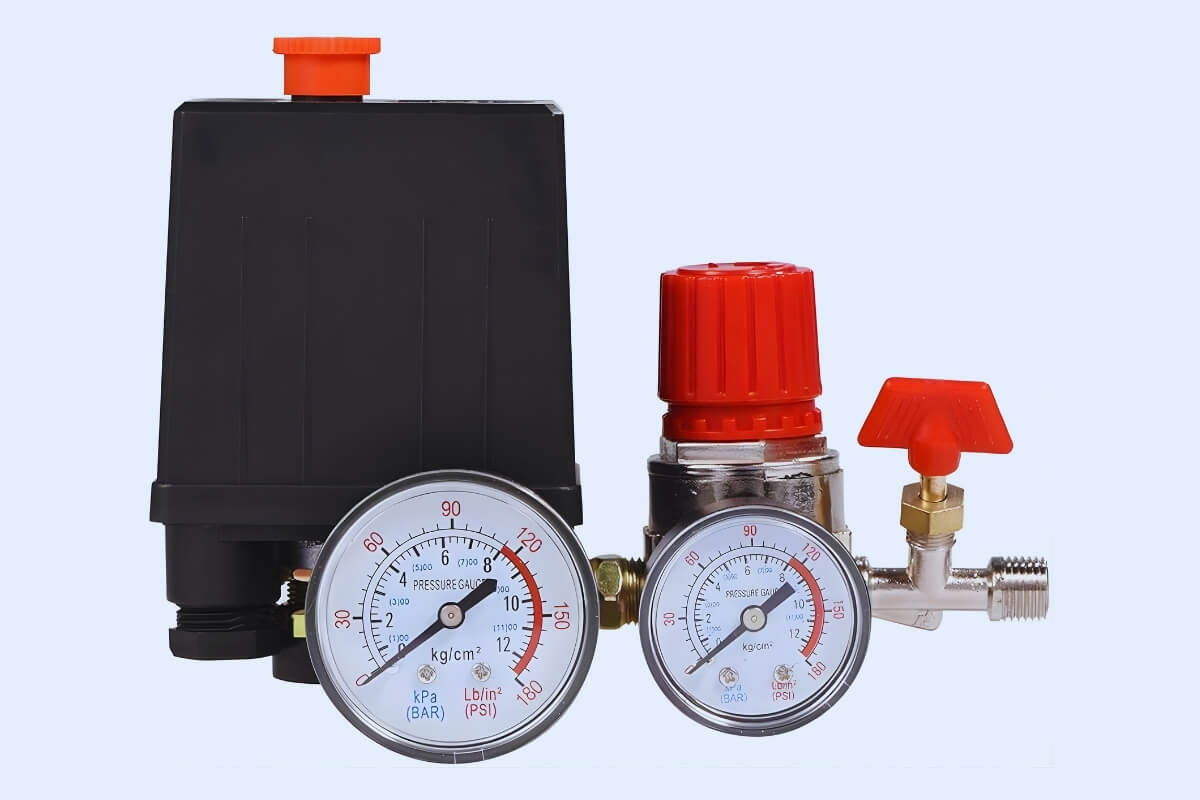
The pressure switch controls when the compressor turns on and off to maintain the required pressure. It signals the motor to start at the cut-in point and stop at the cut-out point. If the switch malfunctions, it may fail to stop the compressor when the set pressure is reached, causing pressure to rise continuously.
A switch stuck in the “on” position can allow the tank to fill beyond its rated psi, potentially causing damage or leaks.
Common failure causes include:
- Contact welding: high-current arcing fuses the contacts and provides continuous power
- Spring fatigue: raises the cut-out pressure
- Contamination: dust or debris blocking the mechanism
- Vibration: shifts adjustment screws and alters settings
- Blocked or damaged pressure sensing line
Testing the pressure switch functionality
Turn off and unplug the compressor. Use a multimeter in continuity mode to test the pressure switch terminals. The switch should show continuity below cut-in pressure and break continuity at the cut-out setting. If it remains closed beyond the rated psi, it is faulty.
Trip the manual lever while the motor is running; the motor should stop immediately. If the compressor continues to run past the recommended psi or the switch fails to activate, the switch is defective.
Repair or replace the pressure switch
- Cut power at the breaker and verify zero voltage with a multimeter.
- Photograph and label the wiring before removal.
- Clean and adjust the switch if dirt or minor mechanical issues are present. If the problem persists, replace it with a manufacturer-approved unit. BISON supplies OEM-equivalent pressure switches in bulk with factory calibration documentation — [contact us for volume pricing and lead time].
- Install the new switch using PTFE tape and calibrate it to the factory-rated cut-out pressure on the unit’s data plate. Never exceed the original specification.
- Always test the compressor after repair by running it and monitoring its operation.
Faulty safety valve
The safety relief valve is the mechanical last line of defense. It releases air when pressure exceeds a safe limit, typically set slightly above the rated cut-out pressure. If the valve is blocked, stuck, damaged, or incorrectly rated, it will not release excess air, creating a dangerous overpressure condition. A chattering valve may indicate that the pressure switch has failed to stop the motor.
Inspection and testing
Pull the safety valve ring while the tank is pressurized. Air should vent freely and stop cleanly when released. Ensure the valve reseats properly after testing.
- If no air is released, the valve does not reset, or a constant hissing sound is present, the valve is defective.
- Verify that the valve’s psi rating is at or below the tank’s maximum allowable working pressure.
- Test the valve regularly to ensure reliability.
Replace any valve that fails to operate correctly or continues to leak. Use only manufacturer-approved components and ensure the replacement matches the tank’s rated pressure, opening below the maximum allowable working pressure. Never bypass or block a safety valve, as this can cause dangerous overpressure.
Incorrect pressure settings
Sometimes excessive pressure is caused by human error. Adjusting the regulator beyond recommended levels can put unnecessary stress on the compressor and attached tools. A miscalibrated cut-out setting allows pressure to exceed the tank’s design rating before shutdown occurs.
Cut-in and cut-out settings define the operating range. Cut-in is the lower restart pressure, commonly 90 psi. Cut-out is the upper limit, commonly 120 to 125 psi.
Adjusting pressure settings
Check the regulator and ensure it is set within the recommended psi range for your tools and compressor. Avoid setting unnecessarily high pressure, as this increases stress on the tank and internal components even if the tool can handle it.
A tall screw adjusts the primary cut-out pressure, while a shorter screw controls the differential. To lower maximum pressure, turn the primary screw counterclockwise. Adjust the cut-out screw first, then fine-tune the differential screw to restore the correct cut-in gap based on manufacturer specifications. Test the compressor through a full cycle after each small adjustment.
Inaccurate pressure gauges and faulty regulators
Pressure regulators and gauges control and display the compressor’s output pressure. If they are faulty or inaccurate, they can mislead users about the actual pressure level and lead to overpressure conditions. Mechanical gauges may fatigue or freeze, creating false or “ghost” overpressure readings.
Example: A gauge reading of 100 psi when the tank is actually at 150 psi can cause the compressor to continue running beyond safe limits.
Gauge accuracy test
Use a calibrated external gauge to compare readings with the compressor’s built-in gauge. If there is a discrepancy greater than 5 psi, the primary gauge is unreliable. Symptoms include significant differences in readings or erratic needle movement, which indicate a faulty gauge.
Replace faulty gauges or regulators to maintain accurate monitoring and control. Periodically check gauges against a calibrated device, especially in high-cycle use, where accuracy can degrade before visible damage occurs. Replace gauges on a scheduled basis to ensure reliability.
Cleaning and replacing the check valve
Access the valve by disconnecting the discharge line at the tank inlet. Remove the valve body to inspect internal components. A worn rubber seat seal may show cracking, flattening, or surface erosion, while a broken or weakened spring will not return the valve disc to the closed position. Debris such as pipe scale, oil residue, or particulate can hold the valve open mechanically. Inspect the check valve disc or ball seat for wear or contamination and replace the unit if the seat is worn.
Repairing or replacing the unloader valve
Diagnose the unloader by listening for a brief hiss at shutdown. No hiss indicates it is not opening, while continuous hissing indicates it is not closing. Clean the plunger and seat if intact, or replace the assembly if components are scored or deformed. If integrated into the pressure switch, replace the entire switch.
Malfunctioning unloader valve
The unloader valve releases head pressure at shutdown. When it fails, the motor may draw excess current and struggle on restart due to residual pressure. Cycle the compressor and listen for a sharp exhaust at the unloader port upon shutdown; silence indicates a stuck or blocked unloader valve. Check for partially closed isolation valves or collapsed hose liners that can create back-pressure and affect proper operation.
Excessive pumping or continuous operation
Continuous operation of the compressor without adequate breaks or overworking can lead to heat buildup and excessive pressure.
- Signs: unusual temperature rise in the tank or motor, repeated pressure surges
- Solution: let the compressor cool down, follow the duty cycle guidelines, and avoid continuous operation beyond the recommended limits
Checking for obstructions in the manifold
Disconnect and inspect the sensing line with a light for carbon or moisture. Use a wire pick to clear the tank port orifice where the sensing line connects. Avoid using compressed air, which can push debris deeper into the port.
Repair or replace internal components
Worn pistons, valves, or seals inside the compressor can cause overpressure.
- Signs of wear: air leaks, unusual noises, or inconsistent pressure readings
- Action: have a professional inspect and replace damaged internal components to restore safe operation
Cleaning and replacing valves and seals
Clean the seat and disc with solvent if the body and spring are intact. Replace the entire valve if the spring is fatigued or the seal is worn.
Cleaning or replacing filters
Dirty or clogged filters disrupt airflow and affect the compressor’s ability to control pressure. Air intake filters or internal valve filters may be clogged with dust, dirt, or oil residue, restricting airflow and interfering with pressure control.
- Inspect the intake filter and replace the element if clogged.
- Remove the air intake filter, then blow or wash away accumulated dust and dirt.
- Replace filters that are damaged, excessively dirty, or worn.
- Schedule filter maintenance based on usage and environmental conditions, as more frequent cleaning may be required in dusty or humid areas.
Inspecting air lines
Inspect the tube for kinks or hairline cracks. A cracked line causes the switch to underread tank pressure. Replace kinked copper lines entirely, as the metal work-hardens and will crack if straightened.
Monitoring operation and running tests
Observe compressor behavior during operation to identify irregularities in pressure build-up. Rapid ramp-up, inconsistent pressure, or longer-than-expected time to reach set pressure may indicate bad internal valves, worn pistons, clogged filters, or incorrect settings.
After corrections, run the compressor under normal operating conditions to verify that the issue is resolved. Watch for pressure buildup and check for irregular spikes. Test the pressure switch and safety valve during operation to ensure proper response.
Keeping a log of pressure readings over time helps detect patterns and prevent future problems. Ensure the unit’s capacity matches actual demand, as undersized units can suffer over-pressurization due to duty cycle mismatches.
Cracked tank welds, damaged pump heads, or failed motor windings require certified repair. If internal tank corrosion is visible through the drain port, remove the unit from service immediately. Repair costs exceeding 50–60% of a new unit’s price rarely make financial sense.
Preventative maintenance to avoid future over-pressurization
Routine inspection and testing
Establish a weekly inspection interval for high-duty equipment or monthly for light use. Cover pressure switch contacts, the unloader valve, and the relief valve. Test the safety relief valve monthly by pulling the ring to confirm it moves freely and reseats cleanly. Verify cut-out pressure quarterly; any drift exceeding 5 PSI above the rated cut-out requires an air compressor pressure switch fix before the next service interval.
Monitoring pressure regularly
Keep an eye on the pressure gauge during operation. Early detection of pressure spikes prevents damage and ensures safety. Digital pressure controllers provide accurate readings and automatic shut-off, reducing human error.
Tank and internal component care
Drain the tank after every session to prevent condensate-induced corrosion and particulate buildup in sensor ports. Over time, moisture builds up in the tank and can lead to corrosion, so drain it daily or weekly depending on climate and usage. Depressurize the tank fully before opening the drain valve.
Check and tighten fittings regularly, as loose connections can cause leaks and pressure fluctuations. Change compressor oil per the manufacturer’s recommended interval and replace intake filters regularly to reduce thermal stress. For oil-lubricated compressors, maintain proper oil levels and change oil regularly to prevent internal wear that can affect pressure control.
Electrical, environmental, and storage maintenance
Keep the electrical housing clean and dry to prevent contact arcing, which can weld contacts closed. Blow out the housing with dry compressed air during inspections. Operate in low-humidity environments and drain tanks completely before seasonal storage.
Preventive maintenance logs
Keep a detailed log of maintenance, inspection, and repair. This ensures long-term safety and performance and helps managers track indicators for planned replacement instead of costly unplanned downtime.

Conclusion
An air compressor that builds up excessive pressure is a serious concern requiring immediate attention. A compressor with air compressor too much pressure is a liability. Maintaining the integrity of the pressure regulation chain is essential for equipment safety and personnel protection.
By understanding the causes, performing regular maintenance, and following safety precautions, you can prevent accidents, extend your equipment’s lifespan, and ensure reliable performance. Regular inspections, proper settings, and working safety devices are key to keeping your air compressor safe and efficient.
Diagnose systematically and judge replacement versus repair honestly. Worn regulation components rarely improve with cleaning, so replace and document any part that fails under pressure cycling stress. Overpressure can be avoided with the appropriate knowledge and proactive measures.
If you are sourcing replacement pressure switches, safety valves, or regulation assemblies at scale, BISON manufactures and supplies these components with OEM/ODM capability and wholesale pricing built for distributors and serious operators.
What working with BISON looks like:
- MOQ from 50 units per SKU, with mixed-SKU order flexibility for maintenance kits
- Standard lead time: 15–25 days; custom-spec orders quoted within 48 hours
- Every pressure switch and safety relief valve is factory-tested to ±3% of rated cut-out pressure before shipment
- OEM labeling, custom PSI ratings, and co-branded technical documentation available on request
- Components certified to ISO 9001 / CE, with full traceability documentation
Our engineering team can match your existing rated pressure specifications or develop new regulation assemblies to spec. Whether you need 100 units or 10,000, BISON’s supply chain is built to support your maintenance cycles — not disrupt them.
Your next compressor should be safer than your last — BISON can help ensure it is.